

Autumn 2026 Hall Experience
— Resumes Oct 4 (Sun)
— Resumes Oct 4 (Sun)
Schedule: Every Sunday in October & November |
9:30–12:00 / 13:30–16:00
9:30–12:00 / 13:30–16:00
Get an up-close look from inside the hall at the 4-meter Dainichi Nyorai statue,
usually only viewable through glass.
usually only viewable through glass.
Introduction
THE FIRST BUTSUZO
Kūkai, the great master of Shingon Buddhism, left these words:
“The esoteric truth is too deep to be conveyed in writing.
Therefore, we reveal it through images, so that even the unawakened may understand.”
THE FIRST BUTSUZO brings this unique method of Shingon into the present.
This statue is not only art. It is a visual embodiment of esoteric teachings—a form that transcends words and speaks directly to the heart, shining light for those who suffer in life.
Concept
The Seven Meanings of “THE FIRST”
The Seven Meanings of
“THE FIRST”
“THE FIRST”
-
01
 Visual FirstTruth is shown first through form, before words.
-
02
 Encounter FirstFor many visitors, especially from abroad, this is their first real encounter with a Japanese Buddha statue.
-
03
 Origin FirstReviving Kūkai’s original vision, lost 500 years ago.
-
04
 Ultimate FirstThe pinnacle of 2,500 years of Buddhist art.
-
05
 Unique FirstA one-of-a-kind Buddha statue—found nowhere else in the world.
-
06
 Future FirstA new step forward: tradition renewed for the future.
-
07
 Experience FirstA once-in-a-lifetime encounter beyond words.
Highlights
-
 01
Eight Lions Supporting the Lotus Throne
Symbolizing the Eight Great Wisdom Kings, placed beneath the lotus seat. Each lion embodies a different divine power. -
 02
Halo with 37 Deities
The halo features a complete three-dimensional realization of the Thirty-Seven Deities of the Diamond Realm Mandala—something seen nowhere else in the world. -
 03
Five Buddhas of the Womb Realm on the Crown
The crown bears five Buddhas in a cross formation, faithfully based on the mandala tradition, but rarely realized in sculpture. -
 04
Shining Glass Parts
Pink glass is used throughout the lotus seat and halo, symbolizing the union of the Womb and Diamond Mandalas. The radiance creates a unique and sacred atmosphere. -
 05
A New Worship Space
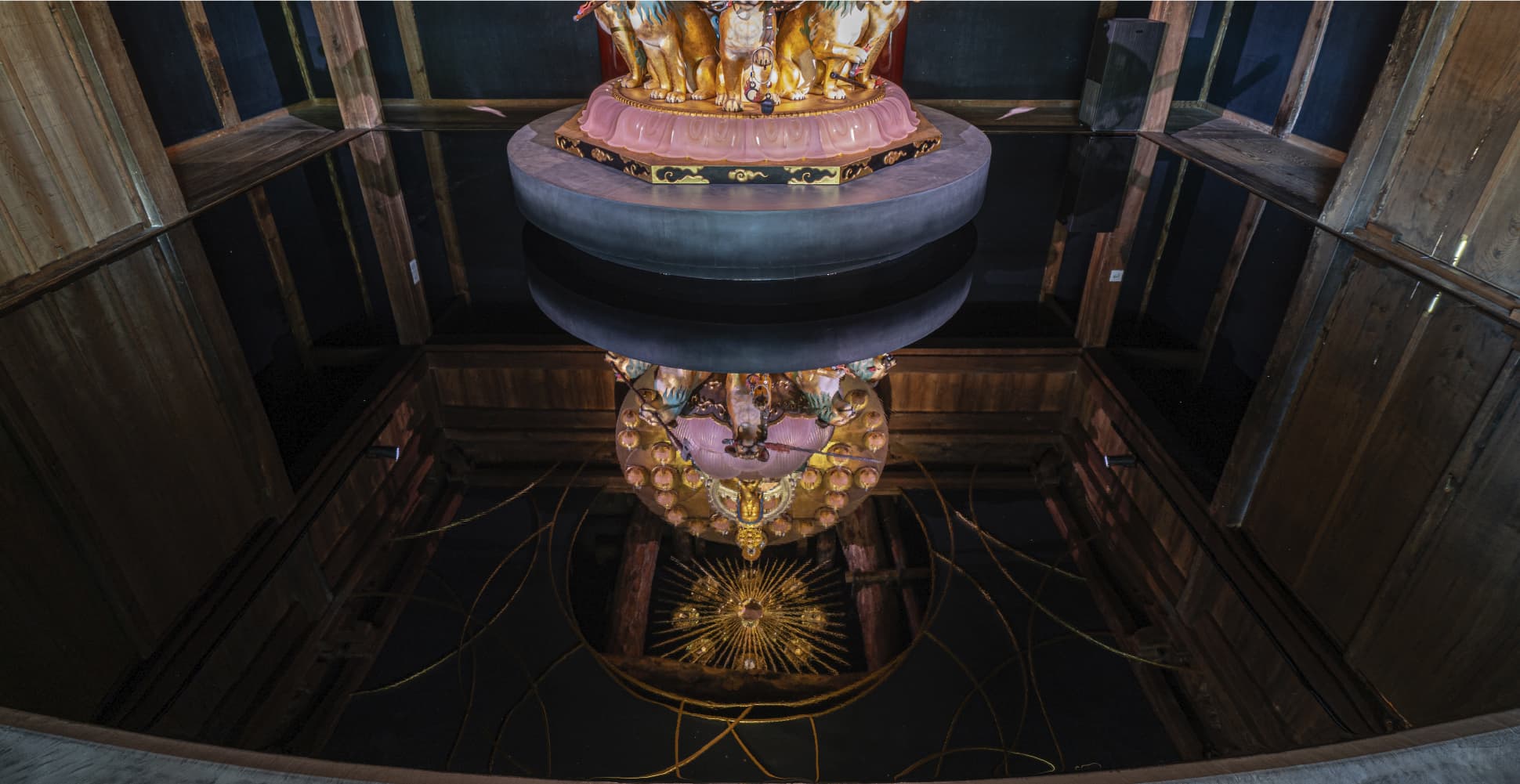
The hall interior, designed by leading contemporary architects, is not a reproduction of the past but a modern sacred space—itself a great work of art. -
 06
Evolved Since
Its Debut Last AutumnSince its initial unveiling in autumn 2025, we’ve continued to refine this space rather than treating it as finished. With a gradient-painted pedestal, additional lighting, and a polished epoxy floor, the illuminated Buddha statue now reflects on the jet-black floor—unifying the statue, light, and architecture into a single immersive space.
Story

The Origin
A Father and Daughter
In the winter after the Great East Japan Earthquake, a couple visited Sanuki Kokubunji with their daughter, who was severely disabled and lying on a stretcher-like wheelchair.
Seeing the father’s deep sorrow, I asked myself: Am I truly offering the salvation they seek?
That question became the seed of my vow—to bring back Kūkai’s lost vision of the Great Dainichi Nyorai.
Seeing the father’s deep sorrow, I asked myself: Am I truly offering the salvation they seek?
That question became the seed of my vow—to bring back Kūkai’s lost vision of the Great Dainichi Nyorai.

The Vow
Reinterpreting Kūkai
I studied ancient documents and, with my training as a Shingon priest, reinterpreted Kūkai’s concept.
Not as a “replica,” but as a new vision enriched by later developments of esoteric thought.
For over ten years I directed every step of its creation, driven by one belief: to deliver hope and salvation to people.
Not as a “replica,” but as a new vision enriched by later developments of esoteric thought.
For over ten years I directed every step of its creation, driven by one belief: to deliver hope and salvation to people.

The Creation
Over Ten Years
Based on my original design, I gave thousands of instructions for every detail—from the lions, to the halo, to the colors.
The statue was realized entirely through donations from thousands of supporters, including nationwide crowdfunding.
This work is both a religious and cultural project of the highest public value.
The statue was realized entirely through donations from thousands of supporters, including nationwide crowdfunding.
This work is both a religious and cultural project of the highest public value.
The Message
Through this statue, I wish to share one message:

Program
See. Feel. Discover.
A jet-black floor, eight lions, a translucent glass lotus pedestal, and a starry expanse across deep blue walls.
This Buddha statue is not meant simply to be "looked at." It was designed to be profoundly felt by immersing yourself in a space where architecture, light, and silence intertwine.
This Buddha statue is not meant simply to be "looked at." It was designed to be profoundly felt by immersing yourself in a space where architecture, light, and silence intertwine.
We call this the "Inner Sanctuary Experience" rather than just a "Special Viewing" because our goal is to give you time to step into the space, learn its meaning, and feel it deeply for yourself.
1. Face the Statue in Silence
We begin without words. Sit quietly face-to-face with the 4-meter-tall seated statue of Dainichi Nyorai (Cosmic Buddha) and simply take in its presence.
2. Special Guidance by the Chief Priest
The chief priest, who directed the project from its initial concept to completion, will personally guide you. He will share the philosophy of Kukai, the architectural significance, and the 15-year journey of its creation.
3. A 360-Degree Exploration
Walk around the statue to closely observe intricate details unseen from the outside, including the beautiful Buddhist paintings on the back of the halo.
4. Reflection and Afterglow
With a deeper understanding of its background, you will face the Buddha once more. After the guided tour, there is no time limit. You are free to stay and reflect at your own pace for as long as you wish.
Visitor Information
|
Dates
|
Every Sunday in April, May, October, and November
|
|---|---|
|
Hours
|
9:30 AM – 12:00 PM / 1:30 PM – 4:00 PM
|
|
Last Entry
|
30 minutes before each session ends (Morning: 11:30 AM / Afternoon: 3:30 PM)
|
|
Venue
|
Sanuki Kokubunji – Great Dainichi Nyorai Hall
Open in Google Maps > |
|
Admission
|
General: ¥1,000 / High School Students & Younger: ¥500 / Donors: Free
|
|
How to Join
|
No booking required. Please stop by the reception during open hours.
Entry is sequential, in groups of about 10 people at a time. *Donors: Please bring your "Donor-Exclusive Hall Experience Program Invitation Ticket." |
Experience the Dainichi Nyorai Statue All Year Round
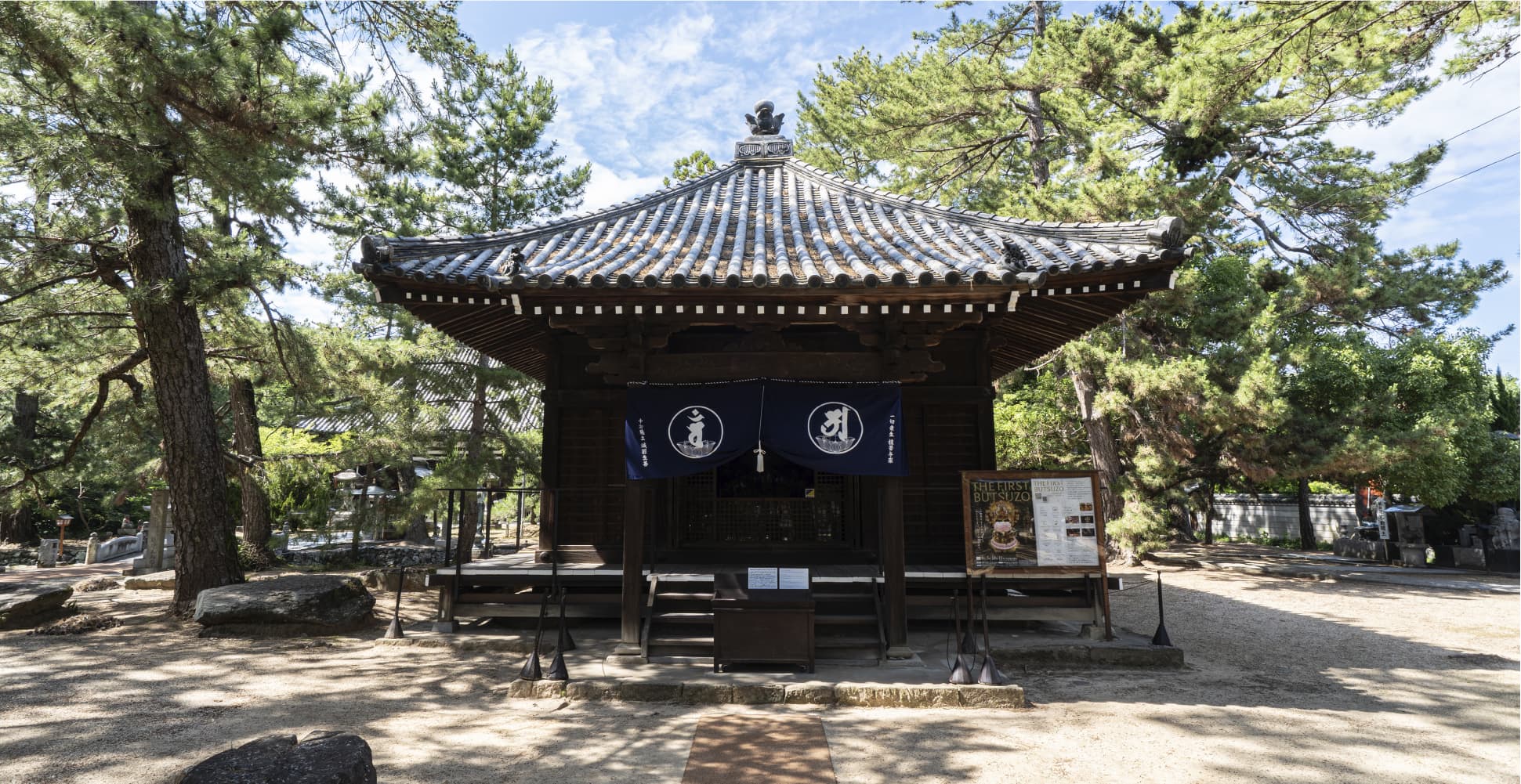
Even outside of the Hall Experience Program, the statue can be viewed free of charge throughout the year through the large, low-reflection glass at the front of the Dainichinyorai-do Hall.
From the outside, the upper half of the Dainichi Nyorai statue is visible.
For a deeper experience of the statue and its sacred atmosphere, we invite you to join our "Hall Experience Program," held on Sundays during spring and autumn.
From the outside, the upper half of the Dainichi Nyorai statue is visible.
For a deeper experience of the statue and its sacred atmosphere, we invite you to join our "Hall Experience Program," held on Sundays during spring and autumn.
|
Purpose of Fees
& Visitor Benefits |
・Admission fees support the reconstruction of Ususama Myōō Hall (temple toilet facilities).
・A commemorative pin badge will be given to all paid visitors.

|
|---|---|
|
Notes &
Exemptions |
・Age Restriction: To maintain a quiet and peaceful environment inside the hall, entry is restricted to visitors aged 10 and older (children under 10 are not permitted).
・Fee Exemption: Free admission is provided for visitors with disabilities who require assistance, as well as one accompanying caregiver. Please present your disability card or official documentation at the reception desk.
|
|
Access
|
Sanuki Kokubunji, Temple No.80 of the Shikoku Pilgrimage
2065 Kokubunji-cho, Takamatsu, Kagawa, Japan Tel: +81-87-874-0033 Parking:
20 parking spaces at main gate (free) 20 bus spaces available 5 min walk from JR Kokubu Station
10 min by car from Takamatsu Nishi / Fuchu Lake IC 25 min by car from Takamatsu Airport ※Temporary parking available |
FAQ
When does the autumn temple experience program start?
The autumn program resumes on Sunday, October 4. It runs every Sunday throughout October and November.
Can I view the Buddha statue on days other than Sundays?
Yes.
You can view the statue for free all year round through the large anti-reflective glass at the front of Dainichi Nyorai-do Hall.
Please note that the "Inside Hall Experience Program" (which allows you to enter the hall) is held every Sunday in April, May, October, and November.
You can view the statue for free all year round through the large anti-reflective glass at the front of Dainichi Nyorai-do Hall.
Please note that the "Inside Hall Experience Program" (which allows you to enter the hall) is held every Sunday in April, May, October, and November.
Do I need a reservation?
No advance reservation is required.
Please visit Dainichi Nyorai Hall during open hours.
Visitors will be guided sequentially in groups of about 10 people.
Please visit Dainichi Nyorai Hall during open hours.
Visitors will be guided sequentially in groups of about 10 people.
What is the Hall Experience Program?
You will be personally guided by the head priest, who conceived, designed, and directed the 13-year creation of this main statue.
During the approximately 30-minute tour, you can walk 360 degrees around the statue while listening to his commentary. This offers a rare opportunity to view intricate craftsmanship and sacred Buddhist paintings behind the halo—details that cannot be seen from the front.
This program is designed to let you experience not just the statue itself, but the entire hall space, including its unique architecture and natural light.
How long should I expect to stay?
The commentary by the chief priest takes approximately 30 minutes. After that, there is no time limit—you are welcome to stay in the hall as long as you like and take in the statues at your own pace.
Can I take photos or videos inside the hall?
No. Photography and video recording are strictly prohibited inside the hall.
We encourage you to view the Buddha statue with your own eyes and truly connect with the space, rather than through a lens or screen. Please step away from taking photos and fully immerse yourself in a unique moment that can only be felt here.
We encourage you to view the Buddha statue with your own eyes and truly connect with the space, rather than through a lens or screen. Please step away from taking photos and fully immerse yourself in a unique moment that can only be felt here.
Are there special admissions for visitors with disabilities?
Yes. Admission is free for visitors with disabilities who require assistance, as well as for one accompanying caregiver.
Can I bring young children into the hall?
To ensure a peaceful and serene environment, we kindly ask that children under 10 years old do not enter the hall.
How much is admission for high school students and younger?
It is 500 yen for high school students and younger.
Is parking available on site?
Yes. Free parking is available in front of the Main Gate, with an additional temporary parking lot on the east side.
Is the temple wheelchair accessible?
Yes, the temple grounds are fully barrier-free and accessible for wheelchair users. However, there are steps leading into the hall. For safety reasons, visitors in wheelchairs are kindly asked to view the interior through the glass.
I received an invitation postcard for the Main Hall Experience Program. Can my family members join me?
Thank you very much for your generous support.
Please note that each invitation is valid only for the named recipient.
If the recipient has passed away or is unable to visit, one proxy may use the invitation in their place.
We kindly ask that accompanying family members purchase a standard admission ticket.
Please note that each invitation is valid only for the named recipient.
If the recipient has passed away or is unable to visit, one proxy may use the invitation in their place.
We kindly ask that accompanying family members purchase a standard admission ticket.
Open
Close